|
||
 |
 |
 |








WHAT IS A CATARACT?
Cataracts affect almost everyone, sooner or later.
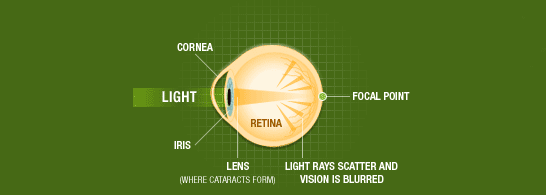
The natural crystalline lens of the eye is made mostly of water and protein. Sometime in a person's 60s, 70s or 80s, some of the protein will clump together, causing the eye's natural lens to become discolored and clouded. This clouding of the natural lens is called a cataract.
When this occurs, light rays passing through the eye become scattered and unfocused. The result is that all objects, whether near or far, become blurry. If left untreated, cataracts can lead to blindness, although this is very uncommon in the United States. To help you better understand cataracts, click here to watch an animation on the development of a cataract.
CATARACTS
The only treatment for a cataract is removal of the affected natural lens of the eye and implantation of a lens implant, or intraocular lens (IOL). This restores the eye's ability to have light pass unobstructed through to the retina. Over 14 million IOL procedures are performed worldwide each year.
Click here to learn more about the procedure.

Indications and Important Safety Information

Indication Statement
ReZoom® multifocal intraocular lenses are indicated for the visual correction of aphakia in adult patients with and without presbyopia in whom a cataractous lens has been removed and who desire near, intermediate, and distance vision without reading add and increased spectacle independence. These devices are intended to be placed in the capsular bag.
Risks
As with many things, there may be a trade off. If you decide to have a multifocal lens, your use of glasses may decrease, but at the cost of losing some of the sharpness of your vision. Even with glasses, this loss of sharpness may become worse under poor visibility conditions, such as dim light or fog. There may also be some visual side effects such as halos and glare from lights at night that are more common than with a monofocal IOL. Halos are rings of light that you may notice when looking directly at a source of light, such as oncoming car headlights. Glare is a scattered light effect that can appear around a source of light.
General risks with cataract surgery and IOL implantation:
Whatever your lens choice is, there are risks and possible complications of cataract surgery and lens implantation. Complications could be minor or temporary, or could permanently affect your vision. Complications are rare and may include the worsening of your vision, bleeding, or infection. Contact your eye doctor right away if you have any of the following symptoms after surgery: itching, pain, flashing lights/"floaters"/a "curtain" in your vision, redness, severe headache, nausea/ vomiting, sensitivity to light or watery eye.
Please note: warnings and precautions accompany all IOLs because they are prescription-only medical devices. The following warnings and precautions apply to all multifocal IOLs.
Warnings
A very small number of patients (less than 1% in U.S. clinical studies) may be dissatisfied and request removal of their multifocal IOL. Under poor visibility conditions, your vision may be reduced more than it would be with a monofocal IOL. Under these conditions, you may have more difficulty recognizing some traffic signs and hard-to-see objects in the road. Therefore, you may need to take extra care when driving, especially in poor light conditions. In rare instances, multifocal IOLs may make some types of retinal surgery more difficult.
Precautions
In a driving simulation study, under one of nine low contrast conditions, 22% more multifocal patients than monofocal patients did not notice a hard-to-see object in the road until they were closer than 100 feet (average distance for multifocal patients was 96 feet; average distance for monofocal patients was 133 feet). The distance of 100 feet is important because at speeds of 30 mph or faster, a driver may not be able to stop safely within 100 feet. In the simulation, however, drivers could also drive around objects, and there was no difference in collisions with the objects.
There is a chance that your vision may not be good enough to read small print without glasses with the multifocal IOL. Please discuss with your doctor whether this is the right lens for you. The following may affect your choice of IOL:
- In rare instances, this lens may make some types of retinal surgery more difficult.
- If the pupil of your eye is very small (less than 2.5 mm), the chances are greater that your near vision with a multifocal lens will not be better than with a monofocal lens.
- If the health of your eye makes it unlikely that your vision will be good after your cataract is removed, you may not get the full benefit of the multifocal IOL.
Adverse Events
The most frequently reported adverse event that occurred during the clinical trial of the Multifocal lens was secondary surgical intervention (including lens repositioning, lens replacement due to biometry error or optical/visual symptoms, vitrectomy/vitreolysis, retinal repair), which occurred at a rate of 2.2%.